Incoterms
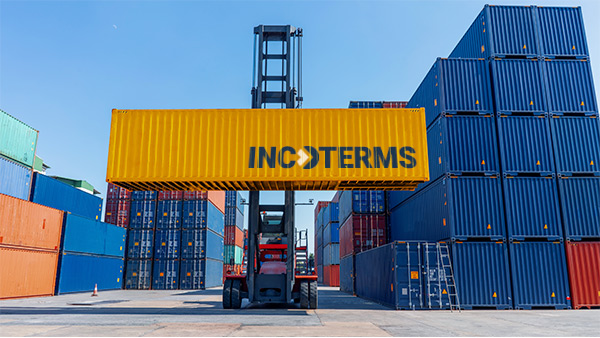
The International Chamber of Commerce’s Incoterms 2020 sets out 11 rules for use in contracts related to domestic and international trade.
As was the case with its predecessor editions, Incoterms 2020 spells out in great detail the obligations of sellers and buyers related to each term, defining respective costs and risks.
• Seven rules may be applied to any mode or modes of transportation, as follow, defined briefly:
1. EXW (Ex Works): Seller delivers the goods to the buyer when it places the goods at the disposal of the buyer at a named place that may or may not be the seller’s premises.
2. FCA (Free Carrier). Seller delivers the goods to the buyer in one of two ways – when loaded on the means of transport arranged by the buyer or when placed in another agreed-upon location.
3. CPT (Carrier Paid to): Seller delivers the goods and transfers risk to the buyer by handing them over to the carrier, contracted by the seller, or by procuring the goods so delivered.
4. CIP (Carriage and Insurance Paid to): Seller delivers the goods and transfers risk to the buyer by handing them over to the carrier, contracted by the seller, or by procuring the goods so delivered, with insurance requirements added.
5. DAP (Delivered at Place): Seller delivers the goods and transfers the risk to the buyer when the goods are placed at the disposal of the buyer, on the arriving means of transport ready for unloading, at the named place of destination or at an agreed-upon point within that place.
6. DPU (Delivered at Place Unloaded). Seller delivers the goods and transfers risk to the buyer when the goods, once unloaded from the arriving means of transport, are placed at the disposal of the buyer at the named place of destination or at an agreed-upon point within that place.
7. DDP (Delivered Duty Paid): Seller delivers the goods to the buyer when the goods are placed at the disposal of the buyer, cleared for import on the arriving means of transport, ready for unloading, at the named place of destination or at an agreed-upon point within that place.
• The remaining four rules may be applied only to sea and inland waterway transport, as follow, defined briefly:
8. FAS (Free Alongside Ship): Seller delivers the goods to the buyer when the goods are placed alongside the vessel, nominated by the buyer, at the named port of shipment or when the seller procures goods already so delivered.
9. FBO (Free On Board): Seller delivers the goods to the buyer onboard the vessel, nominated by the buyer, at the named port of shipment or procures the goods already so delivered.
10. CFR (Cost and Freight): Seller delivers the goods to the buyer onboard the vessel or procures the goods already so delivered.
11. CIF (Cost, Insurance and Freight). Seller delivers the goods to the buyer onboard the vessel or procures the goods already so delivered, with insurance requirements added.
Bulk and Break Bulk incoterms
-LIFO
Liner in/free out. Main freight with loading OTHC included, discharging DTHC not included.
-LILO
Liner in/out. Main freight with loading/discharging THCs included.
-FILO
Free in/liner out. Main freight without loading OTHC and with discharging DTHC included.
-FLT
Full Liner Terms is a shipping arrangement where the carrier assumes full responsibility for all costs associated with loading and unloading cargo at both the port of origin and the destination. This includes covering all freight charges, port handling fees, terminal charges, and wharfage fees. By managing these expenses, FLT simplifies the shipping process, providing a more streamlined and convenient experience for the shipper.
-FIOS
Free in/out and stowed. Loading/discharging THCs are not included. Only main freight including surcharges.
-FIFO
Free in/out. Loading/discharging THCs are not included. Only main freight including surcharges.